
A Very Long Overdue Upgrade Story
osTicket is a small open source project that quietly survived long enough to outlive the web it was originally written for.
If you’ve used osTicket for any meaningful amount of time, you’ve probably noticed something.
It reveals itself the longer you stare at the interface, the longer you click around managing tickets, assigning conversations, and navigating the quiet chaos that is customer support.
At some point a thought appears.
Something like:
“This software remembers Internet Explorer.”
Or maybe:
“I’m pretty sure this UI predates the iPhone.”
And to be completely honest with you… that observation wouldn’t be entirely unfair, in fact it’s very accurate!
Because osTicket has been around for a very long time, since circa 2003!
That’s long enough that parts of it still carry the unmistakable fingerprints of the early web.
And that brings us to a small confession.
Yes. That one is totally on me! It shows my age!
The Original Sin
osTicket began in 2003.
Back then the web was a very different place.
If you were building web applications at the time your toolkit was fairly simple and probably hosted on a share-host. PHP 4 powered most of the dynamic web. MySQL was the database developers reached for when they wanted something powerful without needing a DBA. CSS worked most of the time if you didn’t ask too much of it. JavaScript existed, but it was treated cautiously because browsers had a habit of disagreeing about how it should behave. Ajax was cutting-edge technology!
Frameworks were rare.
Build tools didn’t exist.
Deploying software meant uploading files over FTP and hoping you didn’t accidentally overwrite the wrong directory.
In that environment osTicket made perfect sense.
Support was handled almost entirely through email. Conversations scattered across inboxes. Threads got lost. Messages were forwarded, replied to, forgotten, rediscovered, and occasionally answered twice. Apologizing to customers was a customer support specialization.
Tickets were simply a better way to structure the chaos.
So osTicket began with a straightforward idea: turn messy support emails into organized conversations that teams could track, assign, transfer and resolve. The stated mission was to simply take customer support out of shared-inbox and post-it notes.
What it was not meant to become was a project that would still be running twenty plus years later.
A Project Born on the Interwebz
Like many open source projects of that era, osTicket didn’t begin inside a company.
It began on the interwebz.
In those early days I connected online with another developer named J.Shaun (long lost touch), who was working on a similar idea. We eventually merged our efforts into what became the early foundation of osTicket.
The name itself wasn’t the result of deep brand strategy.
Another popular open source project at the time was osCommerce, and the naming convention seemed good enough. Almost called it MyTTS (story for another day!)
So “osTicket” it was.
No, the “os” does not mean “oh sh*t.” It simply stands for Open Source.
The project grew slowly at first. Then steadily. Then it crossed that strange threshold where people you’ve never met start installing the software in places you’ve never heard of and reaching out for support.
Universities.
Government agencies.
Companies large and small.
At some point osTicket stopped feeling like something I was tinkering with and started feeling like something people were relying on to run real operations.
Which is both deeply gratifying and slightly terrifying.
Because when people depend on software for real work, every change suddenly matters.
Over the years many people contributed to keeping the project moving forward. It would be impossible to list them all here, but a couple of early community members deserve special mention.
Kelli S. contributed heavily during the mid-2000s with Icons and some UI elements when the project was gaining wider adoption, and Jared H. later helped push several architectural improvements that kept the platform evolving through the early 2010s.
Projects like this rarely grow because of a single person.
They grow because communities quietly decide they’re worth keeping alive.
While the Web Moved On
While osTicket continued doing what it had always done — managing tickets and helping support teams stay organized — the rest of the web went through several revolutions.
First came the rise of modern JavaScript.
Then the explosion of frontend frameworks.
Then entire ecosystems built around reactive interfaces and API-driven applications.
User expectations changed.
Interfaces became faster.
Cleaner.
More dynamic.
Some software ages like wine. Some software ages like milk.
osTicket mostly aged like a dependable old truck; still running reliably every day, even if the dashboard looked like it came from another decade.
And through all of that progress osTicket kept doing its job.
It worked, I mean it still works!
It solves the problem it was built to solve.
But there was one place where time had clearly left its mark.
The User Interface.
The Internet, Being the Internet
Open source communities are incredibly supportive.
They contribute patches. They help new users. They answer questions on forums.
They also have a wonderfully sharp sense of humor.
At some point along the way someone created a site that loved osTicket and somewhat hurt it at the same time.
Its mission was simple. Make osTicket look modern. Ouch!
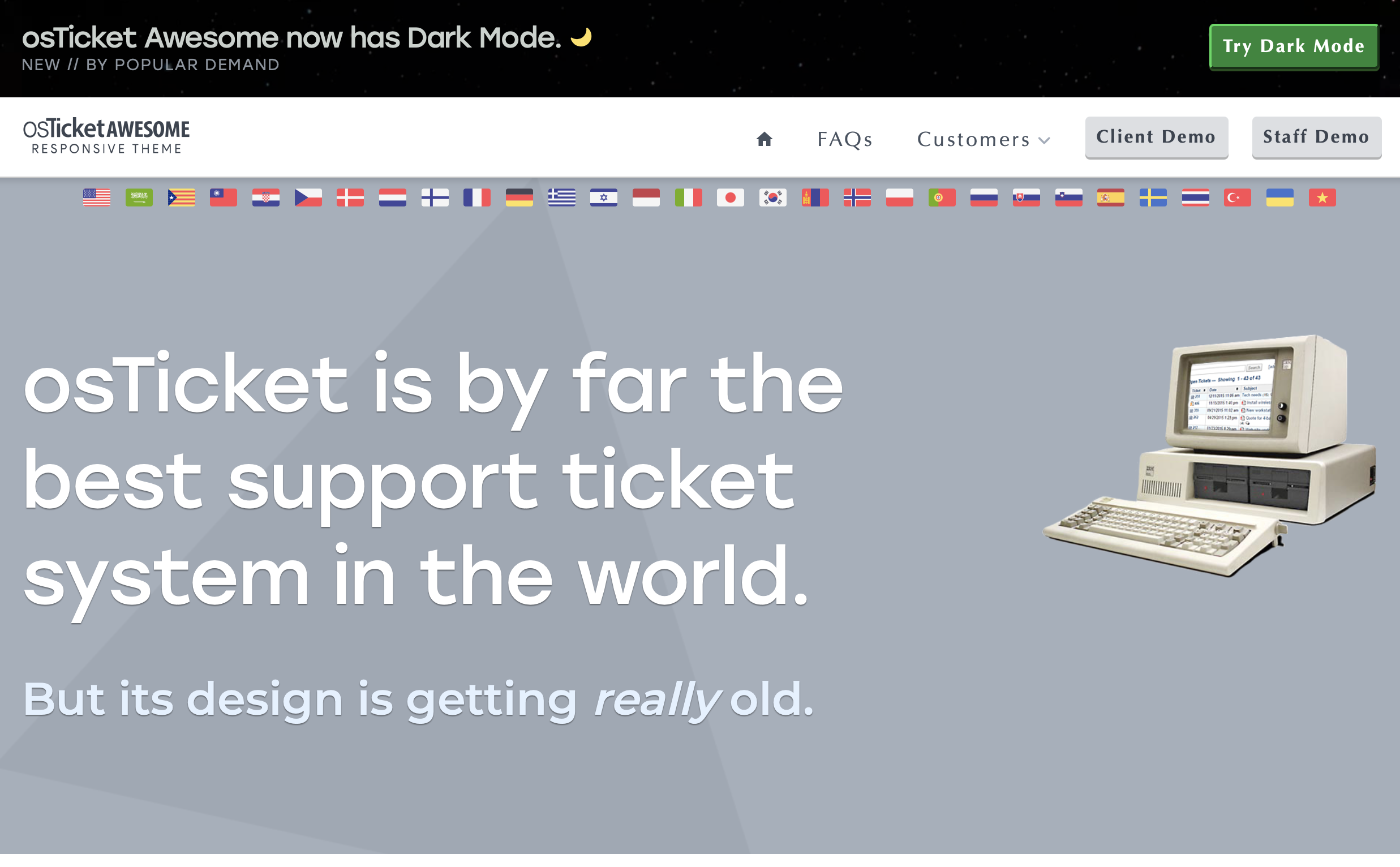
The subtext, however, was equally clear and gut checking.
The community had politely — and somewhat hilariously — pointed out that while osTicket remained incredibly useful, the interface might still be living somewhere around the early 2000s.
And honestly, even with the mild emotional damage, they weren’t wrong.
Ironically, the same community member recently shared a lovely write-up of the project’s early days in the osTicket forum: The osTicket Origin Story.
That’s one of the things I’ve always loved about open source communities — they’ll tease or roast you a little, improve your work, and still show up years later to tell the story. Thanks Comrade, but osTicket 2.0 UI will be Awesome-er!
The lesson here, for us, was clear - when your users build an entire project just to modernize your UI, that’s usually a sign.
A helpful sign.
A slightly embarrassing one perhaps.
But helpful nonetheless.
So we heeded the call, albeit in slow motion!
Why Rewriting It Was Harder Than It Looked
When people see aging software, the obvious question usually follows.
“Why not just rewrite it?”
The truth is that rewriting legacy software is one of the hardest challenges a development team can face.
The hard part isn’t writing new code. Developers love writing new code.
The hard part is replacing two decades of accumulated behavior without losing the lessons embedded inside that code or ignoring the ways thousands of organizations have quietly learned to rely on it.
Developers have been warned about this for a long time.
Back in the early days of the web, Joel Spolsky famously wrote about the dangers of rewriting software from scratch in his essay “Things You Should Never Do, Part I.” His warning wasn’t theoretical. Mature systems contain years of knowledge hidden inside them; bug fixes, edge cases, and decisions made after real users pushed the software in ways its original authors never anticipated.
Ignore that history, and a rewrite can easily become a regression.
Over the years there were several attempts to modernize osTicket.
Many began with enthusiasm.
Some progressed quite far.
Edge cases.
But like countless legacy rewrites before them, they eventually ran into the same reality: mature software contains layers of real-world knowledge that only become visible when you try to replace it.
Hidden assumptions.
Workflows discovered only after thousands of organizations have used the system in ways you never imagined.
Eventually it became clear that osTicket didn’t simply need another rewrite attempt.
It needed the right architecture, the right approach, and the right team committed to seeing it through.
For a long time, the right path forward simply wasn’t obvious!
Joel was right, but over the last several years something changed.
The ecosystem around building software has evolved dramatically; modern frameworks, mature tooling, and platforms that make it possible to rebuild systems in ways that simply weren’t practical twenty — or even five — years ago.
Around that same time we finally assembled the team capable of doing it; a group of engineers willing to study the system, understand its history, respect its use-cases, and rebuild the foundation carefully enough that the next twenty years would be easier than the first.
Just as importantly, we knew the rewrite couldn’t leave the past behind. One of the things osTicket has always been known for is the ability to upgrade from older versions without abandoning the systems people already depend on.
Preserving that path forward mattered just as much as building the new foundation.
Given the right tools.
And more importantly, the right team.
We finally did something that had been talked about for a very long time.
We rebuilt osTicket from the ground up.
Not a patch.
Not a facelift.
A new foundation.
osTicket 2.0.